
Discover the relationship between Macer, the Olympic Games and a Japanese architect.
One of the recommendations of the experts when publishing on LinkedIn is to tell your success stories.
In the ceramics industry, where competition between companies is so high, we have a duty to safeguard the privacy of our clients. In our case, revealing recent success stories can help to give clues about what the company is working on to its direct competitors.
Not surprisingly, the shape of the blocks usually hints at the final format, while the punches themselves just reveal the negative drawing of what will be the future ceramic piece.
For this reason, we think long and hard before publishing content that may be sensitive for our customers.
However, today we bring you a very special case.
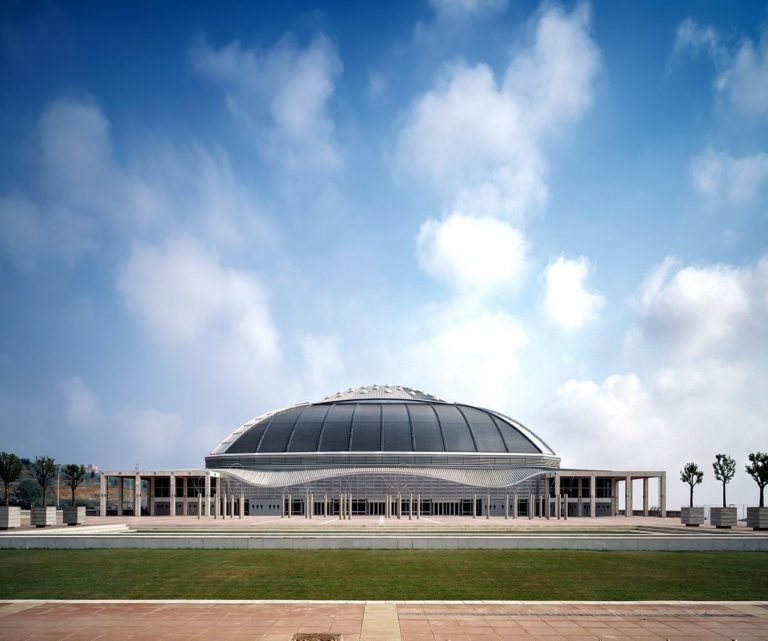
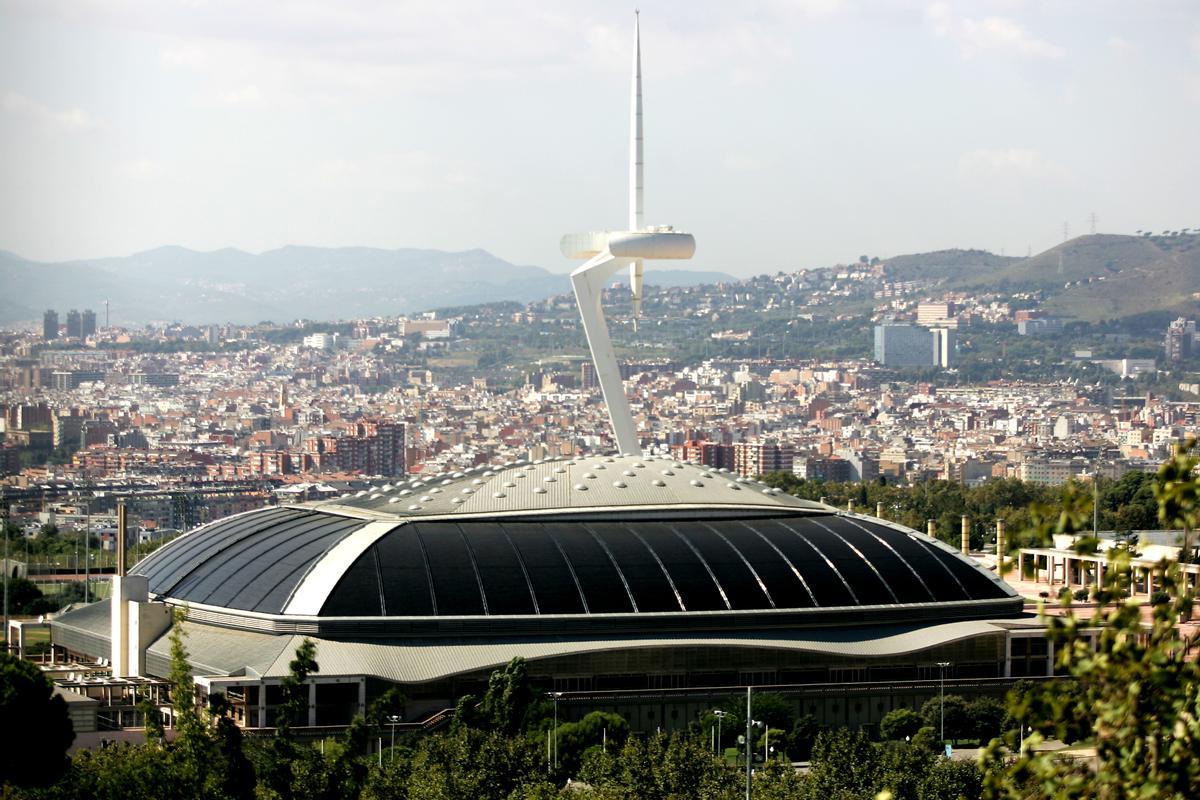
As you will have seen in the photos, it is the Palau Sant Jordi.
The Palau Sant Jordi was designed for the 1992 Olympic Games. Built with bricks, zinc, travertine and tiles.
Yes, we know. It’s some time ago. But it is still an impressive project for its complexity and its beauty. So we decided to rescue it to tell you about it.
Arata Isozaki was commissioned to erect this megalithic structure. The roof, designed for the occasion, is considered a masterpiece of modern architecture and engineering. Its mechanised structure and materials give it great flexibility, allowing it to be adapted to accommodate all kinds of events.
The Uralita group was the firm selected to study, manufacture and assemble the unique roof of the Palau, based on the design by the Japanese architect.
The collection, made up of 13 pieces which they christened Gold Tile, is made up of 20×37.5 cm modules, 8 mm thick, weighing 1.2 kg and with an absorption of less than 2%. Given its application in an emblematic building, it was subjected to all the standardised tests for abrasion resistance, absorption, permeability, flexural strength, frost, thermal shock, acid resistance and scratch resistance, all of which it passed with flying colours.
As a result of this design, a collection of roofing ceramics was born and is still available for sale today.
For the manufacture of these pieces, the Uralita group entrusted Macer to design and manufacture the moulds that would give life to the tiles that would cover the central area of the roof. These pieces were not easy to manufacture.
In the words of Agustín Poyatos, general manager of Macer:
‘These are very complex parts. Their curved shapes and closed angles posed a challenge when designing the moulds, as there were very closed points where tensions were generated in the compaction. In addition, not all parts were flat. The ridge and the pieces with facing or coping also had an added complexity, especially when it came to distributing the load of earth in the mould, so that the pieces would have the same compaction over their entire surface. He thinks that at that time there was not much research on pressing, and bringing such complex pieces to life was a trial and error process. But with the satisfaction of having managed to get a job done that you know sets the standard’.

Initial design sketch by Arata IsozakiThis emblematic building is still to this day the largest indoor sports facility in Barcelona, and one of the most advanced systems in the use of ceramics on roofs due to its formidable development of special pieces as well as its anchoring system.
Built between 1983 (the 30th anniversary of the beginning of its construction) and 1990, its author is considered one of the masters of contemporary Japanese architecture. He is an honorary member of the American Institute of Architects, a member of the Bund Deutscher Architekten and a knight of the Order of Arts and Letters. Isozaki is the 2019 recipient of the prestigious Pritzker Prize, the highest award in the field of architecture, given to those who have produced consistent and significant contributions to humanity through the art of architecture.


